Find the Median of Continuous Distribution
In our article Median for Frequency Type Data, we explained how to calculate the median for ungrouped frequency distribution of a discrete variable. In this article we shall discuss how to calculate the median for grouped frequency distribution of discrete variables as well as continuous variables. For both cases, the method for calculating the median is the same. We shall also discuss a few properties of Median.
Median for Discrete and Continuous Frequency Type Data (grouped data) :
For the grouped frequency distribution of a discrete variable or a continuous variable the calculation of the median involves identifying the median class, i.e. the class containing the median. This can be done by calculating the less than type cumulative frequencies. It should be recalled that less than type cumulative frequencies correspond to the upper class boundaries of the respective classes. First we calculate 


Median or 
where, 


and 
Example: The following distribution represents the number of minutes spent per week by a group of teenagers in going to the movies. Find the median number of minutes spent per by the teenagers in going to the movies.
| Number of minutes per week | Number of teenagers |
| 0-99 | 26 |
| 100-199 | 32 |
| 200-299 | 65 |
| 300-399 | 75 |
| 400-499 | 60 |
| 500-599 | 42 |
Solution:
Let us convert the class intervals given, to class boundaries and construct the less than type cumulative frequency distribution.
| Number of minutes per week | Class Boundaries | Number of teenagers (Frequency) | Cumulative Frequency (less than type) |
| 0-99 | 0-99.5 | 26 | 26 |
| 100-199 | 99.5-199.5 | 32 | 58 |
| 200-299 | 199.5-299.5 | 65 | 123 |
| 300-399 | 299.5-399.5 | 75 | 198 |
| 400-499 | 399.5-499.5 | 60 | 258 |
| 500-599 | 499.5-599.5 | 42 | 300 |
Here, 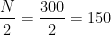
Here, the cumulative frequency just greater than or equal to 150 is 198.


In other words, 299.5-399.5 is the median class, i.e. the class containing the median value.
Median or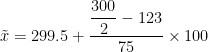
where, 


and 

or, Median (
So, the median number of minutes spent per week by this group of 300 teenagers in going to the movies is 335.5, i.e. there are 150 teenagers for whom the number of minutes spent per week in going to the movies is less than 335.5 and there are another 150 teenagers for whom the number of minutes spent per week in going to the movies is greater than 335.5.
Note:
It is quite clear that in calculating the median of any grouped frequency distribution using this method, the nature of the variable (i.e. discrete or continuous) is of little consequence. Whatever be the nature of the variable, for grouped frequency distributions, this method is exhaustive and will ensure correct calculation of the median.
Properties of Median:
1. If we have two sets of va;ues having medians 


2. If 


Example: Values of two variables, 


Solution:
Here, the median of 
Exercise:
1. Obtain the median for the following frequency distribution of house rent for a sample of 30 families in a certain locality:
| Rent (Rs.) | Number of Families |
| 1800-2000 | 4 |
| 2000-2200 | 7 |
| 2200-2400 | 10 |
| 2400-2600 | 5 |
| 2600-2800 | 2 |
| 2800-3000 | 2 |
2. Frequency distribution of I.Q. of 309 6-year old children is given below:
| Class Intervals | Frequency |
| 40-49 | 1 |
| 50-59 | 2 |
| 60-69 | 3 |
| 70-79 | 5 |
| 80-89 | 17 |
| 90-99 | 65 |
| 100-109 | 69 |
| 110-119 | 79 |
| 120-129 | 37 |
| 130-139 | 19 |
| 140-149 | 7 |
| 150-159 | 3 |
| 160-169 | 2 |
Find the median I.Q. of these children.
Source: https://www.mathstips.com/median-for-discrete-and-continuous-frequency-type/
0 Response to "Find the Median of Continuous Distribution"
Post a Comment